
- Home
- Collection
- Public Art Installation Projects
- 2019 The Tree of Life|Hongyun Culture & Creation, Tainan
2019 The Tree of Life|Hongyun Culture & Creation, Tainan
Artist | Tsai Er-ping
Location| Hongyun Culture & Creation Center, Tainan
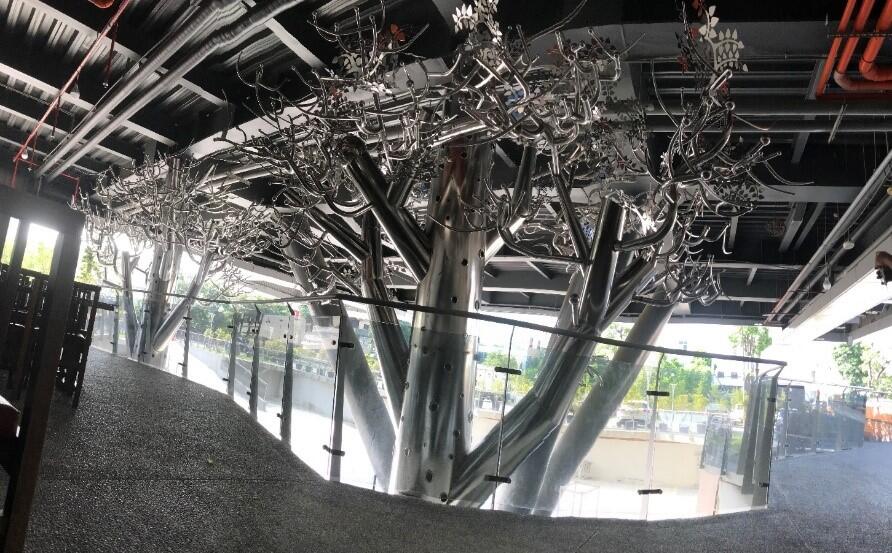
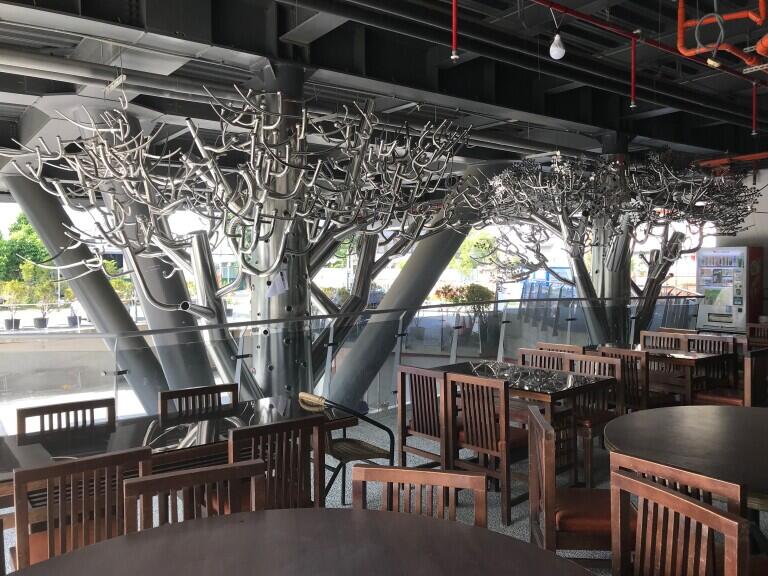
I am deeply honored to have been invited to design and create the Eternal Tree for the Hongyun Cultural and Creative Center. The two trees arch to form a gate, symbolizing that by entering and exiting this Eternal Gate, one can grasp and put into practice the meaning of Three Lives Everlasting and realize their dreams.
The concept of "Three Lives" varies from person to person, but it generally integrates Ecology, Life, and Being as its core values: caring for and protecting the natural environment, fostering a creative attitude toward a healthy mind, body, and spirit, embracing the harmony of a circular economy with social and cultural ethics, and realizing one’s own life value and meaning, which is the true essence of a community of life.
Trees: My Faith and My Inspiration
I have loved trees since I was a child. My entire life, I have climbed, planted, and protected them. Trees have also become my faith. I have sought out forests everywhere and built two homes. One is my "Huai Xiang Yuan" (Nostalgia Garden) in the U.S., a home to rare flowers and unique plants. The other is a deeply affectionate ecological garden I co-created with my siblings in Beigang.
As a tree lover, I also care about the relationship between trees and human history and civilization. I have always believed that a tree is like the connection between heaven, earth, and humanity, like a mother's umbilical cord. Its branches and leaves absorb the essence of day and night, and its roots draw the nutrients from the earth’s core. It blossoms, bears fruit, grows into a forest, nurtures all things, and provides shade for all beings. For me, using trees in my creations to honor the heavens, cherish the earth, and revere the divine is a sacred act.
Looking back at the history of ancient human civilizations, there are similar artifacts of "Eternal Trees" with sacrificial meanings and religious beliefs. They were passed down to future generations in the form of totems, stone carvings, bronze ware, and written paintings. In ancient civilizations like those mentioned in the Bible, the Classic of Mountains and Seas, Sanxingdui, ancient India, Sumeria, and and Assyria, we can see their sacred, worshipped significance. The trees also hold different meanings, symbolizing the Tree of Wisdom, the Tree of Life, or the Tree of Clan Proliferation.
In the primitive era, without trees and forests to provide fire for warmth, to cook food, to build nests, to sharpen wood into knives and spears for hunting and defense, and to make tools for farming, boats, carts, bridges, and cities, humanity could not have survived, thrived, and evolved into the masters of all things.
The Meaning Behind the Trees
In the Bible, some famous tree species existed in the Middle East at the time. The Cedars of Lebanon (Cedrus libani), for example, were used to build Solomon's Temple and represent majesty, fertility, and abundance. The wood used for Noah's Ark was likely a local cypress. In depictions of Jesus's baptism in the Jordan River, the riverside plants include olive trees and palm trees. In those days, people used palm leaves for roofing to provide shade and protection from sandstorms, and its fibers for ropes. Willow branches were used for wall panels, woven baskets, and furniture, while wild oak was used for firewood. As for Adam and Eve in the Garden of Eden, the apple they ate was a type of Malus pumila.
At the Hongyun Cultural and Creative Center, the two stainless steel Eternal Trees arch to form the "Eternal Gate," which symbolizes obtaining eternal life through faith. The trees were created based on the characteristics of the Beech tree (Fagus grandiflora). In ancient times, it was considered the Tree of Wisdom. People often carved wise words or prayers onto its massive, silvery-gray bark. Lovers also carved their sacred vows, which is why linguists have traced the origin of the word "book" back to "beech" in ancient Indo-European languages.
Just as flowers have a language, so do trees. The symbolism of the Beech tree in the West represents learning, wisdom, understanding, sustenance, knowledge, preservation, and progress. This allows us to interpret the stainless steel tree gate as a gate to imperishable eternal life.
I have also welded many tags with words of blessing onto the stainless steel tree trunks. I invite everyone to add more blessings to make the world a better place.
Thank you all. - Tsai Er-ping